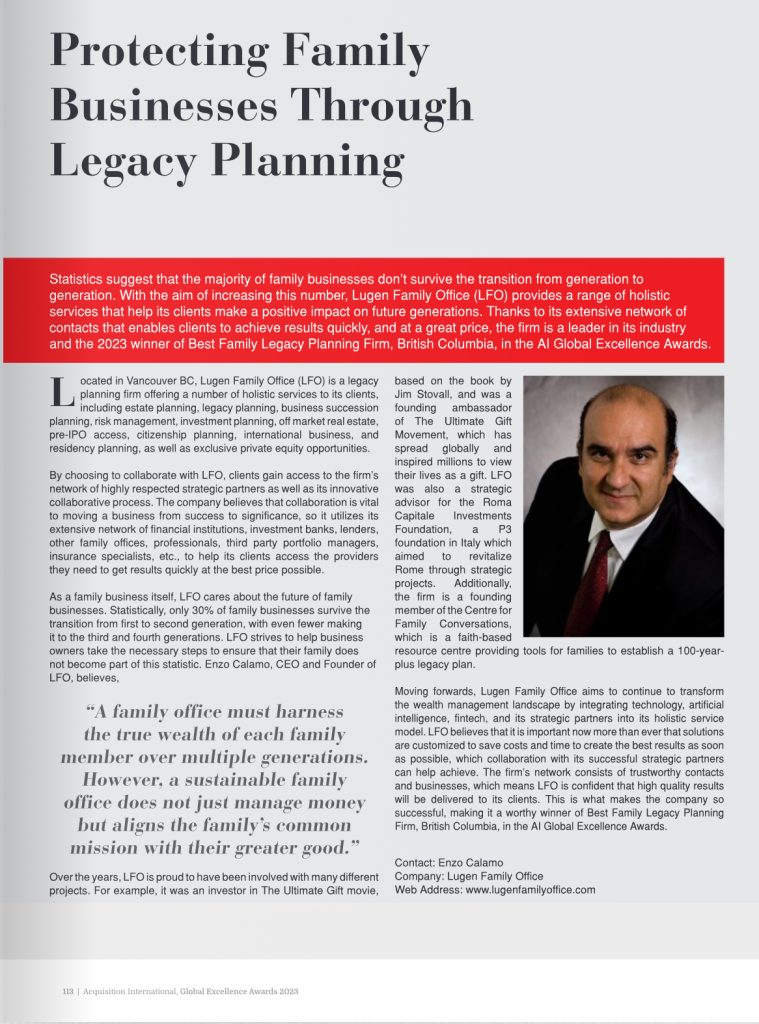
Meet Enzo Calamo








Awards for Enzo Calamo and Lugen Family Office:
2025 Lifetime Contribution Award, Financial Hall of Fame. – Enzo Calamo
2025 Lifetime Contribution Award, Canadian Insurance Hall of Fame. – Enzo Calamo
2025 Best Legacy Planning Services Provider, Acquisition International Magazine. – Lugen Family Office
2024 Best Legacy Planning Firm, BC, Acquisition International Magazine. – Lugen Family Office
2024, Honorary Doctor of Divinity, Universal Life Church. – Enzo Calamo
2024, Best Legacy Planning Firm, Canada, Corporate America Today. Lugen Family Office
2023, Canada’s Best 20 CEOs to Watch, The Inc Magazine. – Enzo Calamo
2023 Best Legacy Planning Firm, BC, Acquisition International Magazine. – Lugen Family Office
2016, Family Office of the Year, Wealth & Finance International Magazine. – Lugen Family Office
2016, Best Selling Author, Amazon Kindle. – Enzo Calamo
2015 – Present, Gold Award Curator, Scoop.it. – Enzo Calamo
Enzo Calamo
Founder and CEO
Lugen Family Office, Medici Family Office
“OVER 1 MILLION SOCIAL MEDIA FOLLOWERS”
Degrees:
Bachelor of Commerce, University of Calgary
Bachelor of Arts, University of Calgary,
Bachelor of Laws, University of Alberta
Previously Held Designations:
Chartered Life Underwriter
Registered Financial Consultant
Certified Financial Planner
Registered Financial Planner
Trust and Estate Practitioner
Certified Senior Advisor
Kolbe Certified Consultant
Team Interplay Consultant
Ultimate Gift Ambassador
Tony Robbins’ Programs,
Russell Brunson’s Program

THE HOUSE OF BRANDELLI
Emerging from the noble traditions of Northern Italy, the House of Brandelli traces its origins to the early fourteenth century, rooted within the historic centers of Verona, Bologna, and Florence—regions that shaped the political, commercial, and cultural foundations of Renaissance Europe.
In Verona, under the rule of the Scaligeri, Giusto, son of Vanno, rose as a trusted authority entrusted with civic and financial responsibility during an era when governance demanded discipline, loyalty, and strategic judgment. By 1409, the family had earned distinction within the Noble Council, reflecting not merely recognition, but confidence in a house whose standing was built through contribution, stewardship, and enduring service.
As the centuries unfolded, the Brandelli presence expanded across Emilia, Tuscany, and Lazio, establishing a broader territorial and intellectual influence. In Bologna, records from 1426 identify Giovanni Antonio Brandelli among the notable figures of his era, marking the family’s continued integration into centers of governance, commerce, and civic administration.
It was in Florence, however, that the House of Brandelli matured within the same civic and cultural environment that gave rise to the great Renaissance houses of Italy. During an age where banking, diplomacy, governance, commerce, and patronage shaped the future of Europe, Florence stood as the intellectual and financial heart of the Renaissance world.
While history remembers the Medici as architects of Renaissance Florence, the stability and advancement of that civilization were sustained by many noble and governing houses whose influence extended through administration, alliances, stewardship, and disciplined continuity across generations. Within this Florentine framework, the House of Brandelli emerged as part of the broader institutional fabric that defined the era.
Like the great Florentine houses of the Renaissance, the Brandelli lineage understood that enduring influence was not sustained through wealth alone, but through governance, strategic alliances, patronage, responsibility, and the disciplined transfer of wisdom across generations.
This philosophy became embedded within the identity of the House itself.
In Florence, the lineage advanced into positions of prominence and administration. Giacomo Brandelli, serving as Governor of the ancient Duchy of Mirandola, exemplified the family’s commitment to disciplined leadership and institutional responsibility. The family’s standing was further affirmed through burial within the Church of San Felice—a distinction reserved for those whose lives reflected recognized stature, contribution, and continuity of legacy.
Beyond governance, the House of Brandelli demonstrated strategic foresight through alliances of significance, most notably through union with the Marchetti family, linking the lineage to the Marquisate of Gazzano and the Barony of Sant’Agata La Motta. These alliances reflected a deeper principle understood by the Renaissance houses of Italy: that legacy is not merely preserved through bloodline, but strengthened through alignment, wisdom, and shared purpose.
Unlike houses defined solely by title or territory, the Brandelli legacy was forged through merit, continuity of presence, disciplined evolution, and enduring contribution across generations. Their recognition among the Nobili was not incidental, but earned through action, stewardship, and institutional trust.
The heraldic crest of the House reflects this identity with deliberate symbolism.
The lions and crown signify authority, vigilance, and rightful standing. The knight’s helm embodies readiness, discipline, and the enduring duty to protect both family and principle. The great silver wings positioned behind the shield represent elevation, guardianship, and the aspiration to rise beyond the limitations of a single generation.
Within the upper quadrant, the original silver heraldic wings remain preserved as symbols of ancestral wisdom, inherited honor, and continuity with the founding lineage of the House. They serve as a reminder that true legacy is strengthened not through abandonment of tradition, but through faithful preservation of foundational principles.
At the center of the crest, the golden infinity emblem stands as the defining symbol of the modern House of Brandelli. Positioned upon the forward shield, it represents infinite stewardship, perpetual continuity, and the enduring responsibility to carry wisdom, prosperity, and purpose across generations yet unborn.
It reflects a philosophy deeply rooted in the Renaissance tradition itself:
that wealth without wisdom is temporary,
but wisdom carried across generations becomes civilization.
The golden star above the shield symbolizes higher purpose, guidance, and unwavering direction.
Encircled by ornamentation of gold, silver, and crimson, the crest reflects a philosophy where strength is governed by restraint, power is balanced by wisdom, and prosperity exists in service to continuity rather than excess.
Across regions,
across centuries,
across generations,
one principle remains unchanged:
The House of Brandelli is not defined by a moment in history,
but by its continuity through time.
Declaration
This is not merely a history.
It is a standard.
Legacy is not inherited through title alone.
It is built through action,
protected through discipline,
guided through wisdom,
and passed forward with intention.
The duty of one generation
is to strengthen the foundation of the next.
For prosperity without wisdom is fleeting,
but wisdom carried across generations
becomes eternal.
Prosperitas cum Sapientia Traditur
Prosperity is handed down with wisdom.


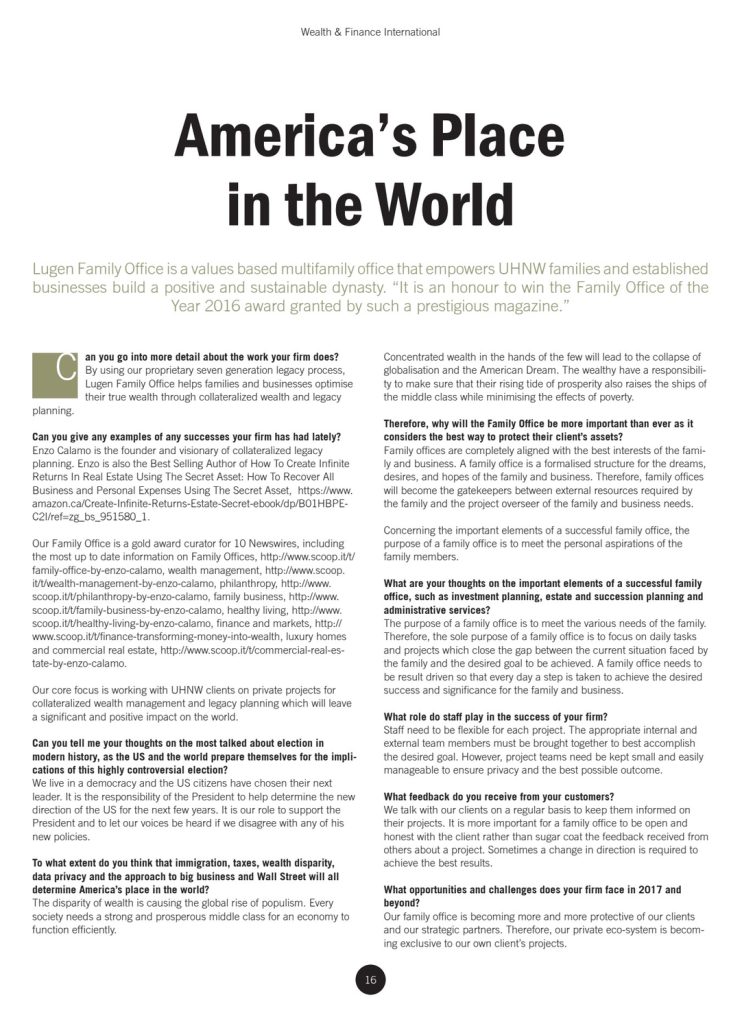
Family Office of the Year 2016 - Wealth & Finance International
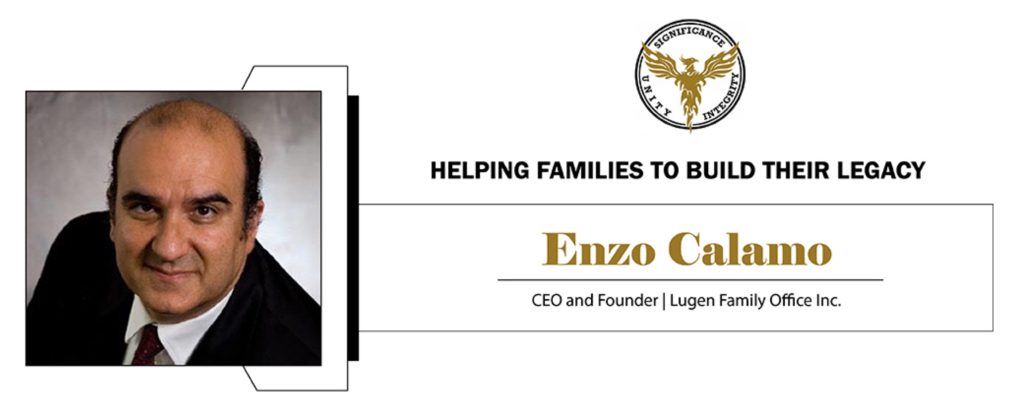
Canada's 20 Best CEO's to Watch in 2023
Enzo Calamo: Helping Families to Build their Legacy
Global Excellence Award 2023 - Aquisition International Magazine